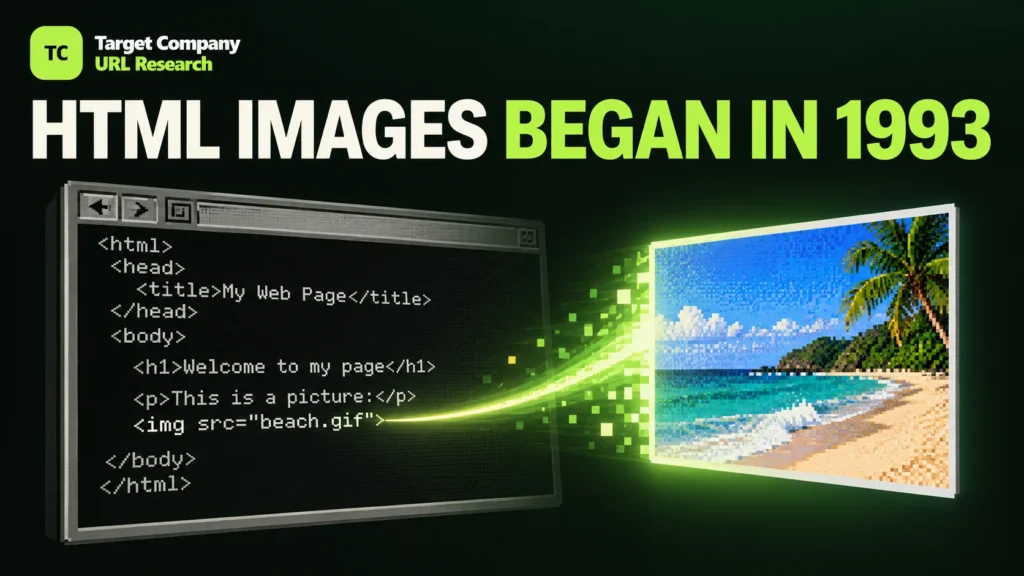
HTML images first appeared in 1993. On 25 February of that year, Marc Andreessen proposed the IMG element so a browser could display a picture directly within a web page. His message said the feature was already working in X Mosaic. The element was later included in the formal HTML 2.0 specification published in November 1995.
That gives us two dates worth remembering. 1993 marks the arrival of images within HTML pages. 1995 marks their inclusion in a formal HTML specification. Neither date should be confused with the date an image file was first placed on the Web.
What did a web page look like before IMG?
The early Web was built primarily for sharing documents. A page could contain headings, paragraphs and links to other resources. Pictures were not yet the familiar part of a page that they are today.
Imagine reading an article about a scientific instrument. The text could point you toward a picture, but opening that picture was a separate action. It would not necessarily appear beside the paragraph explaining it. For a reader used to today’s websites, that is a surprisingly large difference.
The challenge was not simply storing an image online. The browser needed a way to know where an image belonged in the document and which file to retrieve. A link could take someone to a picture. What was missing was a widely adopted way to place that picture inside the flow of an HTML page.
The proposal that changed HTML
Andreessen addressed that problem in a message to the web development community on 25 February 1993. He proposed a new HTML tag called IMG, with a SRC value identifying the image file.
The idea was direct: when the browser reached the tag, it would fetch the named image and display it at that point in the text. A writer could place a diagram next to its explanation or show a small icon within a page. Andreessen also noted that the image could be placed inside a link, making the picture clickable.
One detail in the original message is easy to miss. Andreessen was not describing an idea that existed only on paper. He said it was already working in X Mosaic and would be used internally. So 25 February is a strong documented date for the public proposal, but it should not be presented as the exact day someone first tested the feature.
The original proposal also left browsers some freedom over image formats. If a browser could not display a particular file, it could show a placeholder. That flexibility mattered at a time when web browsers and image support were still developing rapidly.
Why Mosaic mattered
A new element becomes important only when people can actually use it. NCSA Mosaic helped turn inline images into a visible part of browsing during 1993.
“Inline” means the picture appears within the page itself rather than requiring the reader to open a separate image. That sounds ordinary now, but it changed how a web document could communicate. A picture could clarify an instruction, identify a place, illustrate an object or simply make a page easier to understand at a glance.
Think again of the scientific article. Instead of asking readers to leave the text to view a diagram, its author could put the diagram where it was needed. The same principle later shaped product pages, news stories, tutorials and blogs.
This does not mean Mosaic invented every form of online image viewing. It means the browser helped popularize the particular experience people now associate with an HTML image: a picture appearing as part of the page.
So why do some sources say 1995?
The 1995 date refers to formal documentation, not the first use of the idea.
HTML developed through proposals, browser features and community practice before all its familiar parts were gathered into a formal specification. HTML 2.0, published in November 1995, described the IMG element and its attributes, including SRC for the image address and ALT for alternative text.
In other words, a feature could be used on the Web before a later specification recorded it. Saying “HTML images began in 1995” overlooks the 1993 proposal and browser implementation. Saying “HTML 2.0 formally documented IMG in 1995” is accurate.
This distinction is useful beyond web history. Technologies often begin as working experiments. Documentation and standards may follow after people have already started using them.
Was IMG the first image on the Web?
Not necessarily, and that is a different question.
An image file can exist on a web server without appearing inside an HTML page. A page can also link to a picture that opens separately. The IMG element is about embedding a picture at a chosen position within the page.
That is why a claim about the first photograph uploaded to the Web cannot, by itself, answer when HTML images began. One concerns an image file and its publication. The other concerns an HTML feature and how browsers displayed it.
When researching this topic, it helps to ask exactly what “first image” means. Are we talking about the first image file available through the Web, the first picture a browser could open, or the first picture displayed inside an HTML document? Those questions may have different answers.
What remains of that 1993 idea today?
The basic idea remains remarkably familiar. A modern page can still use an image element like this:
<img src="picture.jpg" alt="A mountain at sunset">Here, src tells the browser which picture to load. The alt text describes the image when a reader cannot see it or when the image does not load. Modern browsers, formats and accessibility practices have developed considerably since 1993, but the central instruction is recognizable: place this image here.
That simplicity explains the lasting importance of the original proposal. It gave authors a practical way to combine words and pictures in one document. The result was not merely a more decorative Web. It was a Web better able to explain, demonstrate and tell stories.
The answer in one sentence
The HTML IMG element was publicly proposed on 25 February 1993, with an implementation already working in X Mosaic; inline images spread through web browsing during 1993, and HTML 2.0 formally documented the element in November 1995.
A startup’s tool budget should also fit its wider financial plan. Before committing to paid software, estimate what the business can afford and how long its available cash must last. If you are considering loans, investors or a funding adviser, our Growth Navigate funding guide explains the checks to make before paying for help.